


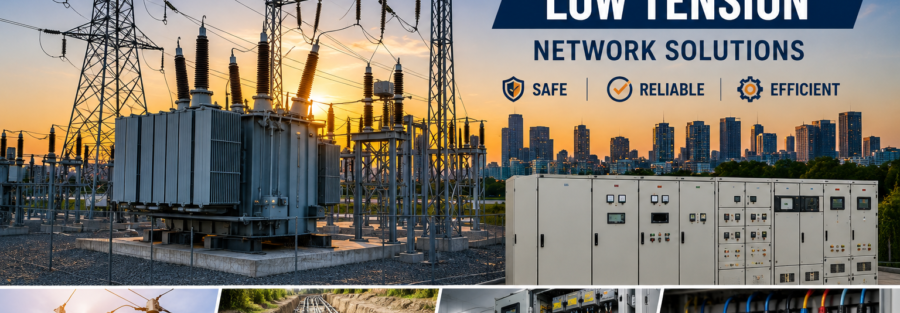
Reliable electricity distribution is the foundation of modern residential, commercial, industrial, and infrastructure development. From large manufacturing facilities and commercial complexes to residential communities and public infrastructure, every project depends on a safe and efficient electrical network to deliver power where it is needed.
A well-designed High Tension (HT) and Low Tension (LT) electrical network ensures that electricity can be distributed efficiently from the power source to the final point of consumption. However, designing and installing these networks requires specialized engineering knowledge, quality equipment, professional installation practices, safety procedures, and regular maintenance.
This is why choosing the right electrical contractor is critical.
Metro Engineers Services provides complete High Tension & Low Tension Network Services for commercial, residential, industrial, and infrastructure projects. The company handles the network lifecycle from planning and design to installation, testing, commissioning, and maintenance, with a focus on safety, reliability, quality, and operational performance.
In this comprehensive guide, we will discuss HT and LT networks, their importance, major components, applications, installation requirements, challenges, and why Metro Engineers Services can be a dependable choice for HT & LT electrical network projects in Jaipur and beyond.
What Are High Tension and Low Tension Networks?
Electrical power is generated at power stations and then transmitted and distributed through different voltage levels. Depending on the application and stage of distribution, electrical networks may operate at different voltage levels.
High Tension (HT) Network
A High Tension network is used for distributing electrical power at higher voltage levels, generally for large commercial, industrial, institutional, and infrastructure requirements.
HT systems are commonly associated with:
- Industrial power distribution
- Large commercial facilities
- Electrical substations
- Manufacturing plants
- Infrastructure projects
- Large residential developments
- Power-intensive facilities
Because HT systems involve higher electrical energy levels, their design, installation, testing, and maintenance require trained professionals and appropriate safety procedures.
Low Tension (LT) Network
Low Tension networks distribute electrical power at lower voltage levels suitable for end-use applications.
LT systems are commonly used for:
- Residential buildings
- Commercial buildings
- Offices
- Shops
- Lighting systems
- Small industrial loads
- Building services
- Distribution boards
HT and LT networks often work together as part of an integrated electrical distribution system.
Why HT & LT Networks Are Important
Electrical distribution is not simply about connecting a power source to electrical equipment. The network must be designed to deliver power safely, efficiently, and reliably.
A professionally engineered HT & LT network provides several important benefits.
- Reliable Power Distribution
A properly designed network helps distribute electrical power consistently across different areas of a project.
This is especially important for industries and commercial facilities where unexpected power interruptions can affect productivity and business operations.
- Electrical Safety
HT and LT electrical systems involve significant electrical hazards. Proper protection systems, earthing, cable selection, isolation, and installation procedures are essential for safe operation.
- Efficient Power Utilization
Good network design helps reduce unnecessary electrical losses and ensures that equipment receives suitable power according to its requirements.
- Scalability
Modern electrical networks should be designed with future expansion in mind. A scalable system makes it easier to add additional loads or facilities as the project grows.
- Better Equipment Protection
Proper electrical protection can help protect transformers, cables, switchgear, panels, motors, and other equipment from abnormal electrical conditions.
Major Components of HT Networks
A High Tension electrical network can include several important components depending on project requirements.
HT Cables
HT cables are used to transmit and distribute electrical power between different points in the electrical network.
Proper cable selection depends on factors such as:
- Load requirement
- Voltage level
- Installation method
- Cable length
- Environmental conditions
- Fault level
- Future expansion
Transformers
Transformers are used to change voltage levels according to the requirements of the electrical distribution system.
They play a critical role in connecting different sections of electrical infrastructure.
HT Panels and Switchgear
HT switchgear provides control, isolation, protection, and switching functions within the electrical system.
Protection Systems
Electrical protection systems are designed to detect abnormal conditions and help isolate affected sections of the network.
Earthing Systems
Proper earthing is a fundamental safety requirement for electrical infrastructure.
Major Components of LT Networks
LT networks typically include:
- LT distribution panels
- Distribution boards
- LT cables
- MCC panels
- PCC panels
- Switchgear
- Circuit breakers
- Metering systems
- Control panels
- Earthing systems
- Building distribution systems
The exact configuration depends on the nature and size of the project.
HT & LT Network Design and Engineering
One of the most important stages of an electrical project is system design.
Before installation begins, engineers need to understand the project’s electrical requirements.
This may include:
- Connected load
- Maximum demand
- Power factor
- Distribution requirements
- Cable routes
- Transformer requirements
- Panel requirements
- Protection requirements
- Earthing
- Future load growth
- Site conditions
Metro Engineers Services provides HT and LT network solutions starting from planning and design, followed by installation, testing, commissioning, and maintenance.
This end-to-end approach helps maintain continuity between engineering design and actual field execution.
HT & LT Cable Installation
Cable installation is a critical component of electrical network construction.
Depending on the project, cables may be installed through:
- Underground trenches
- Cable ducts
- Cable trays
- Conduits
- Industrial cable routes
- Dedicated electrical corridors
Professional cable installation requires attention to:
- Correct cable sizing
- Bending radius
- Mechanical protection
- Cable identification
- Proper termination
- Separation requirements
- Earthing
- Testing
Improper cable installation can lead to overheating, insulation damage, electrical faults, and reduced system life.
Testing and Commissioning of HT & LT Networks
Electrical testing is essential before a network is placed into normal operation.
Testing and commissioning can include verification of:
- Cable integrity
- Insulation condition
- Electrical connections
- Earthing
- Protection systems
- Switchgear
- Panels
- Transformers
- Control circuits
- Functional operation
The objective is to identify potential problems before the system becomes fully operational.
Metro Engineers Services includes testing and commissioning within its complete HT and LT network service offering.
HT & LT Network Maintenance
Even a professionally installed electrical network requires regular maintenance.
Preventive maintenance helps identify potential issues before they become major failures.
Maintenance activities may include:
Electrical Inspection
Regular inspection helps identify loose connections, damaged components, overheating, corrosion, or other issues.
Cable Inspection
Cable condition and termination points should be checked periodically.
Panel Maintenance
Switchgear and distribution panels require appropriate inspection and servicing.
Protection System Testing
Protection devices should be checked to ensure that they operate correctly.
Earthing Inspection
Earthing systems should be inspected and maintained to support electrical safety.
Thermal Inspection
Thermal inspection can help identify abnormal heating in electrical connections and equipment.
Metro Engineers Services provides reliable maintenance and technical support as part of its HT and LT network services.
Applications of HT & LT Electrical Networks
HT and LT networks are required across a wide range of sectors.
Industrial Projects
Industrial facilities often require substantial electrical infrastructure to operate:
- Production machinery
- Motors
- Pumps
- Compressors
- HVAC equipment
- Industrial lighting
- Automation systems
A dependable HT/LT network helps provide the electrical foundation required for these operations.
Commercial Buildings
Commercial properties require electricity for:
- Lighting
- HVAC
- Elevators
- Fire protection systems
- IT infrastructure
- Security systems
- Office equipment
Professional electrical distribution is essential for maintaining business continuity.
Residential Developments
Large residential projects, apartments, gated communities, and townships require carefully planned LT distribution systems and may also require HT infrastructure depending on their power requirements.
Infrastructure Projects
HT and LT networks are also important for:
- Roads
- Public facilities
- Transportation infrastructure
- Industrial infrastructure
- Government projects
- Large development projects
Challenges in HT & LT Network Projects
Electrical network projects can involve several technical challenges.
Load Variation
Electrical demand can change throughout the day and over the lifetime of a facility.
A system designed without considering future demand may become inadequate as the project expands.
Voltage Drop
Long cable routes and inadequate cable sizing can result in voltage drop.
Proper engineering helps minimize such issues.
Electrical Faults
Short circuits, insulation failures, equipment faults, and other abnormal conditions can affect network reliability.
Appropriate protection and system design are therefore essential.
Environmental Conditions
Outdoor and industrial electrical equipment may be exposed to:
- Heat
- Dust
- Moisture
- Rain
- Chemicals
- Mechanical stress
Equipment selection and installation methods should take site conditions into account.
Maintenance Access
Electrical infrastructure should be designed so that equipment can be inspected and maintained safely.
Why Professional HT & LT Contractors Matter
Electrical networks are complex infrastructure systems. Attempting to reduce project costs by compromising on engineering, equipment quality, installation practices, or testing can create significant long-term risks.
A professional electrical contractor can help ensure:
- Correct system design
- Appropriate equipment selection
- Proper installation
- Electrical safety
- System testing
- Reliable commissioning
- Maintenance support
- Better project coordination
The contractor’s role is therefore not limited to physical installation. It extends across engineering, project execution, quality assurance, safety, and lifecycle support.
Why Choose Metro Engineers Services?
Metro Engineers Services has developed its HT & LT network service around reliability, safety, engineering expertise, and complete project execution.
According to the company’s service page, its electrical construction team specializes in complete HT and LT network solutions for commercial, residential, industrial, and infrastructure projects.
Here are some key reasons to consider Metro Engineers Services.
- Experienced Electrical Engineering & Construction Team
HT and LT projects require both engineering knowledge and practical field experience.
Metro Engineers Services highlights its experienced electrical engineering and construction team as one of its key strengths.
This combination can help bridge the gap between system design and site execution.
- Complete Project Lifecycle Support
Instead of handling only installation, Metro Engineers Services provides services across the project lifecycle:
Planning → Design → Installation → Testing → Commissioning → Maintenance
This integrated model can simplify project coordination and provide clients with a single technical partner.
- Safety-Focused Network Solutions
Electrical safety should be a priority in every HT and LT project.
Metro Engineers Services emphasizes safe and standards-compliant network solutions.
This includes attention to appropriate installation practices, protection, testing, and operational reliability.
- Modern Installation Techniques
Electrical infrastructure is continuously evolving.
Metro Engineers Services states that it uses modern installation techniques and sophisticated equipment for its network projects.
Modern tools and methods can improve installation quality, efficiency, and project execution.
- Customized Electrical Solutions
No two projects have exactly the same requirements.
A manufacturing plant may have completely different electrical requirements from a residential township or commercial building.
Metro Engineers Services provides tailored solutions for commercial and industrial projects based on project requirements.
This customized approach allows the electrical network to be aligned with the actual application.
- Focus on Quality Assurance
Electrical infrastructure is a long-term investment.
Poor-quality materials or workmanship can result in frequent breakdowns and higher maintenance expenses.
Metro Engineers Services emphasizes timely execution along with quality assurance.
- Reliable Maintenance & Technical Support
A contractor’s responsibility should not necessarily end when installation is completed.
Ongoing technical support and maintenance can help organizations maintain reliable electrical infrastructure.
Metro Engineers Services offers maintenance and technical support for HT and LT network systems.
Metro Engineers Services for HT & LT Networks in Jaipur
For organizations developing electrical infrastructure in Jaipur, selecting a locally accessible engineering partner can simplify communication, site coordination, inspection, and maintenance.
Metro Engineers Services is based at E-615, Near Amrapali Circle, Vaishali Nagar, Jaipur-302021. The company lists +91-8440016116 and mesprojectjpr@gmail.com as its contact details.
Its HT & LT network services are positioned for residential, commercial, industrial, and infrastructure projects.
How to Select the Right HT & LT Network Contractor
Before choosing an electrical contractor, project owners should evaluate several factors.
Technical Experience
Check whether the contractor has experience with projects similar to yours.
Engineering Capability
A contractor should be able to understand electrical loads, network design, protection, cable sizing, and distribution requirements.
Safety Practices
Ask about safety procedures, testing, earthing, protection, and site execution standards.
Quality of Materials
Equipment and materials should be selected according to the project’s technical requirements.
Project Management
Good project coordination helps reduce delays and installation problems.
Testing & Commissioning
Ensure the contractor provides appropriate testing and commissioning before handover.
Maintenance Support
Long-term technical support can be valuable for maintaining network reliability.
Benefits of a Properly Designed HT & LT Network
A professional electrical network can provide several long-term benefits:
- Reliable power distribution
- Improved electrical safety
- Better system performance
- Reduced electrical losses
- Protection of electrical equipment
- Easier maintenance
- Improved scalability
- Better operational continuity
- Reduced risk of unexpected failures
These benefits make professional HT & LT network engineering an important investment rather than simply an installation expense.
Future-Ready Electrical Networks
Modern electrical infrastructure is becoming increasingly connected and intelligent.
Future-ready electrical networks can integrate with:
- Renewable energy
- Solar power systems
- Smart meters
- Energy monitoring
- Automated controls
- Backup power systems
- Industrial automation
- Building management systems
This makes it important to consider future requirements when designing today’s electrical infrastructure.
Metro Engineers Services also provides Solar Power System solutions, creating opportunities for customers to integrate renewable energy with broader electrical infrastructure planning.
Conclusion
High Tension and Low Tension networks form the backbone of reliable electrical distribution for residential, commercial, industrial, and infrastructure projects.
From HT cables, transformers, switchgear, and protection systems to LT panels, distribution boards, cables, and building electrical networks, every component needs to be carefully designed and professionally installed.
A successful HT & LT project requires much more than electrical installation. It requires engineering expertise, proper planning, quality materials, safe installation, testing, commissioning, and ongoing maintenance.
Metro Engineers Services provides complete HT & LT network solutions covering planning, design, installation, testing, commissioning, and maintenance. The company emphasizes experienced engineering professionals, safe and standards-compliant solutions, modern installation techniques, customized project execution, quality assurance, and technical support.
For businesses, industries, developers, and infrastructure organizations looking for a reliable HT & LT Electrical Network Contractor in Jaipur, Metro Engineers Services can provide an integrated approach to electrical network development.
Whether you are developing a new industrial facility, commercial building, residential township, or infrastructure project, a properly engineered electrical network can provide the reliability and safety needed for long-term operation.
Looking for reliable High Tension & Low Tension Network Services? Contact Metro Engineers Services to discuss your project requirements and develop a customized electrical network solution.
Metro Engineers Services – Building Safe, Reliable & Efficient Electrical Networks for a Better-Powered Future.
Frequently Asked Questions
- What are HT and LT networks?
HT stands for High Tension and LT stands for Low Tension. HT networks are generally used for higher-voltage power distribution, while LT networks distribute electricity at lower voltage levels to end-use applications.
- What HT & LT services does Metro Engineers Services provide?
Metro Engineers Services provides planning, design, installation, testing, commissioning, maintenance, and technical support for HT and LT electrical networks.
- Does Metro Engineers Services handle industrial HT & LT projects?
Yes. The company’s HT & LT service offering covers commercial, residential, industrial, and infrastructure projects.
- Why is HT & LT network design important?
Proper design helps ensure appropriate power distribution, electrical safety, equipment protection, efficient operation, and future scalability.
- Does Metro Engineers Services provide maintenance services?
Yes. Maintenance and technical support are part of the company’s HT & LT network services.
- Does the company provide testing and commissioning?
Yes. Testing and commissioning are included in Metro Engineers Services’ complete HT and LT network solutions.
- Can HT & LT networks be integrated with solar power?
Yes. Solar power generation can be integrated with electrical distribution infrastructure when the system is appropriately designed and engineered.
- Why should I hire a professional HT & LT contractor?
Professional contractors provide engineering expertise, appropriate equipment selection, safe installation, testing, commissioning, and maintenance support, helping improve network reliability and safety.
- Where is Metro Engineers Services located?
Metro Engineers Services is located at E-615, Near Amrapali Circle, Vaishali Nagar, Jaipur-302021.
- How can I contact Metro Engineers Services?
You can contact Metro Engineers Services at +91-8440016116 or mesprojectjpr@gmail.com for project discussions and technical requirements.